
Author: M2320BDS

  • The Generational Shift in the American Workforce

    The Generational Shift in the American Workforce

    The Generational Shift in the American Workforce: When Millennials Move Into the Driver’s Seat

    By Montgomery 2320 Business Development Services LLC

    There is a significant shift taking place inside the American workforce—and it is bigger than a simple change in age demographics.

    The center of gravity of American business is moving.

    For years, Generation X occupied a unique position in the workforce. They were the generation that came of age between the industrial economy and the digital economy. They experienced business before the internet became infrastructure, then spent much of their careers adapting organizations to computers, email, websites, mobile technology, social media, cloud computing, and eventually artificial intelligence.

    But that position is changing.

    Millennials are now firmly established as the largest generational cohort in the U.S. labor force.

    According to Pew Research Center’s analysis of U.S. Census Bureau data, Millennials surpassed Generation X as the largest generation in the American labor force in 2016. In 2017, approximately 56 million Millennials were working or looking for work, compared with approximately 53 million Gen X workers and 41 million Baby Boomers. Millennials represented about 35% of the labor force at that point.

    That was not a temporary anomaly.

    It represented the beginning of a broader generational transition.

    This Isn’t About One Generation Losing

    The phrase “Millennials are replacing Gen X” can be misleading.

    Generational workforce transitions do not normally happen because one generation suddenly takes jobs away from another.

    They happen because people move through economic and professional stages.

    Generation X is now largely in its peak senior-career years. Millennials are moving into their 30s and 40s—the ages when workers increasingly enter management, build companies, acquire businesses, become executives, and assume greater responsibility for organizational performance.

    Meanwhile, the youngest Millennials are no longer young workers.

    They are experienced professionals.

    Many have 15–20 years of workforce experience.

    That matters.

    The Millennial generation entered adulthood during a period defined by the internet, globalization, the Great Recession, smartphones, social media, cloud computing, remote work, and now artificial intelligence.

    They did not simply learn how to use technology.

    Technology became part of the environment in which they learned to work.

    That distinction is becoming increasingly important for businesses.

    The Numbers Tell the Story

    The U.S. Bureau of Labor Statistics does not officially classify workers by generations. Its labor-force data are organized primarily by age, because “Millennial” and “Generation X” are demographic classifications rather than government labor-force categories.

    But the age data clearly demonstrate the underlying transition.

    In 2025, the United States had approximately 170.8 million people in the civilian labor force.

    Workers between 25 and 54—the core working-age population—accounted for approximately 109.5 million of those workers. Within that population, approximately 37.9 million were ages 25–34 and 38.3 million were ages 35–44.

    Those age groups contain the overwhelming majority of today’s Millennials, along with the oldest members of Generation Z and some younger members of Generation X depending on the generational definition being used.

    The important point isn’t simply the headcount.

    It is what these workers are doing.

    They are increasingly managing departments.

    They are becoming executives.

    They are launching companies.

    They are acquiring businesses.

    They are running sales organizations.

    They are operating technology systems.

    They are making capital decisions.

    And increasingly, they are responsible for deciding what the next generation of American business looks like.

    Generation X Built the Bridge

    This is where the story gets interesting.

    Generation X occupies an unusual place in American economic history.

    Gen X experienced the transition from analog to digital firsthand.

    Many entered the workforce when:

    – Fax machines were still normal business infrastructure.
    – Paper files were everywhere.
    – Mainframe systems dominated large organizations.
    – Long-distance telephone calls were expensive.
    – Websites were still emerging.
    – Email was not yet universal.
    – Business relationships were heavily dependent upon face-to-face networking.
    – Sales depended heavily upon telephone calls, meetings, direct mail and referrals.

    Then the world changed.

    Gen X adapted.

    They implemented personal computers.

    They adopted enterprise software.

    They built websites.

    They learned digital marketing.

    They managed increasingly complex supply chains.

    They navigated the rise of social media.

    They implemented cloud systems.

    And now they are confronting artificial intelligence.

    In other words, Generation X became the bridge between two business eras.

    That experience is extremely valuable.

    But experience alone does not guarantee that an organization will successfully navigate the next transition.

    Millennials Are Inheriting a Different Business Environment

    The Millennial generation is stepping into leadership during a radically different operating environment.

    The modern business owner is dealing with:

    Artificial intelligence.

    Automation.

    Cybersecurity.

    Digital customer acquisition.

    Data-driven decision making.

    Remote and distributed work.

    Globalized competition.

    Supply-chain volatility.

    Higher capital costs.

    Regulatory complexity.

    Rapid technological obsolescence.

    The traditional business model—hire people, sell products, manage expenses and repeat—still exists.

    But the infrastructure supporting that model has fundamentally changed.

    Today’s business leader must understand not only people and products, but also data, technology, capital, digital infrastructure, intellectual property, automation, customer acquisition systems and increasingly sophisticated risk.

    This is where the Millennial transition becomes economically significant.

    Education Is Another Part of the Story

    There is also an important difference in educational attainment.

    Pew Research Center found that in 2016, approximately 40% of Millennial workers ages 25–29 had at least a bachelor’s degree, compared with approximately 32% of Generation X workers when they were the same age. Among Millennial women ages 25–29, the figure was approximately 46%, compared with 36% among Gen X women at the comparable age.

    That doesn’t mean education automatically produces better business leadership.

    It doesn’t.

    Experience, judgment, character, execution, relationships and the ability to make sound decisions still matter enormously.

    But it does mean that today’s younger management population is entering leadership with a different educational and technological foundation than previous generations.

    And that changes the talent pool available to American companies.

    The Real Issue for Business Owners

    At Montgomery 2320 Business Development Services LLC, we believe this is where the conversation needs to move beyond generational stereotypes.

    The question isn’t:

    “Are Millennials better than Gen X?”

    That’s the wrong question.

    The better questions are:

    Who understands the business?

    Who understands the technology?

    Who understands the customer?

    Who understands capital?

    Who can execute?

    Who can build relationships?

    Who can lead people?

    Who can adapt?

    And perhaps most importantly:

    Can the organization combine the experience of one generation with the technological fluency of another?

    That is where the opportunity exists.

    The Generational Combination May Be More Powerful Than the Generational Competition

    Imagine a company where:

    Generation X provides institutional knowledge, operational experience, customer relationships, business judgment and decades of hard-earned lessons.

    Millennials provide digital fluency, technology adoption, modern management practices, data utilization and a willingness to redesign outdated systems.

    Generation Z contributes AI-native thinking, emerging consumer behavior, new communication patterns and a fundamentally different relationship with technology.

    That isn’t displacement.

    That’s succession.

    That’s organizational evolution.

    And that is the conversation American business owners need to be having.

    The Next Business Cycle Will Reward Adaptability

    The U.S. Bureau of Labor Statistics projects the civilian labor force to grow from approximately 170.8 million in 2025 to 176.3 million by 2035, a relatively modest 3.2% increase over the decade. At the same time, the composition of the workforce will continue changing as older workers age and younger generations assume larger shares of responsibility.

    That creates a strategic problem for business owners.

    There simply isn’t an unlimited supply of experienced people waiting to replace everyone who retires.

    Businesses have to develop people.

    They have to transfer knowledge.

    They have to document processes.

    They have to build systems.

    They have to create leadership pipelines.

    They have to make institutional knowledge transferable.

    And they have to understand how technology can increase the productive capacity of the organization.

    This is especially important for privately held companies and small businesses.

    A company cannot depend upon one person knowing everything.

    That isn’t infrastructure.

    That’s institutional vulnerability.

    The Business Owner’s Challenge

    The next decade will require business owners to think differently about succession.

    Succession is no longer simply:

    “Who takes over when I retire?”

    It is becoming:

    “How do I transfer knowledge, relationships, authority, systems, ownership and decision-making capacity before the transition becomes an emergency?”

    That’s a completely different question.

    And it requires planning.

    It requires documentation.

    It requires leadership development.

    It requires financial discipline.

    It requires technology.

    It requires business intelligence.

    And it requires an honest assessment of what the organization actually owns, what it depends upon and where its vulnerabilities exist.

    This Is Where Montgomery 2320 BDS Fits

    Montgomery 2320 Business Development Services LLC exists in this space.

    We don’t view business development as simply selling more.

    We view business development as building business infrastructure.

    That means helping leaders understand the relationship between:

    People + Processes + Technology + Capital + Customers + Risk + Opportunity.

    Because the workforce is changing.

    The customer is changing.

    Technology is changing.

    Capital is changing.

    Supply chains are changing.

    And the businesses that survive these transitions will not necessarily be the businesses with the most employees or the largest budgets.

    They will be the businesses capable of adapting their infrastructure faster than their environment changes.

    The Millennial Moment Is Already Here

    The Millennial generation did not suddenly arrive in American business.

    It has been moving upward for years.

    The evidence shows that Millennials became the largest generational group in the U.S. labor force in 2016. A decade later, the implications of that transition are becoming much more visible in management, entrepreneurship, technology adoption and organizational succession.

    But the opportunity isn’t to declare one generation the winner.

    The opportunity is to build organizations capable of using the strengths of all of them.

    Generation X has knowledge that cannot simply be downloaded.

    Millennials have capabilities that cannot be ignored.

    Generation Z is bringing another technological transition behind them.

    The smart business owner doesn’t choose one generation.

    The smart business owner builds a system where experience can be transferred, talent can be developed and technology can multiply human capability.

    That’s the future of business development.

    And that’s why at Montgomery 2320 BDS, we continue to believe:

    We don’t just talk about business.

    We build it.

    We build the systems.

    We build the relationships.

    We build the leadership capacity.

    We build for what comes next.

    Montgomery 2320 Business Development Services LLC

    Helping Leaders Lead Better.

    Helping Businesses Build for What’s Next.
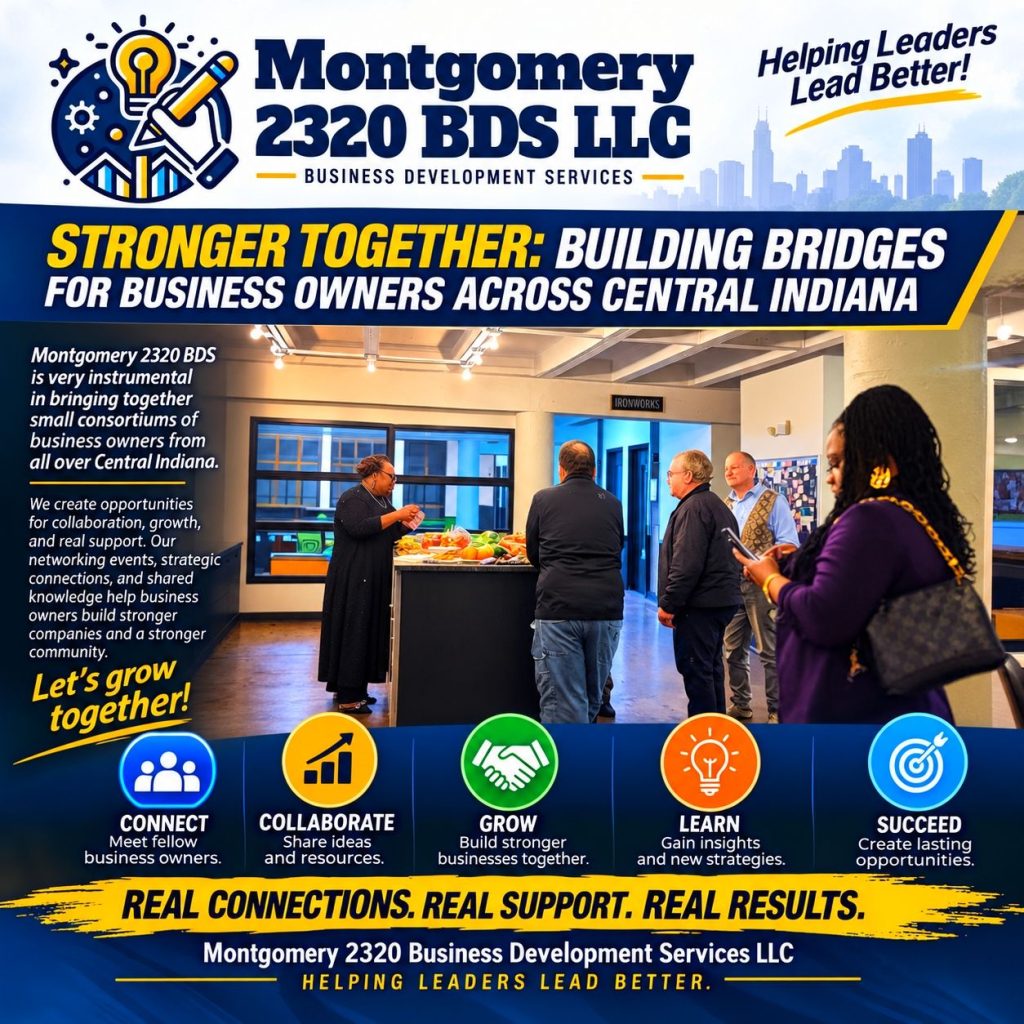
    Montgomery 2320 Business Seminar 2026
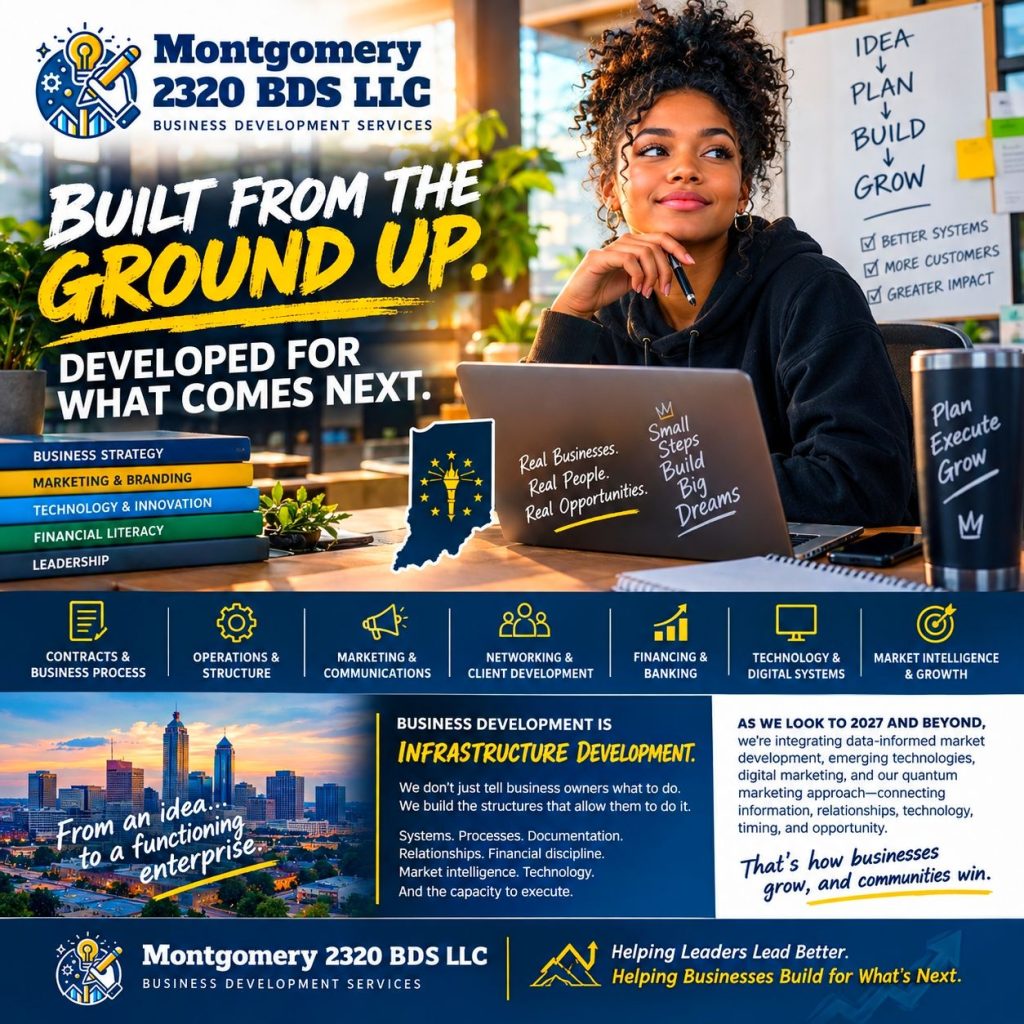
  • Built From the Ground Up. Developed for What Comes Next.

    Built From the Ground Up. Developed for What Comes Next.

    Future Business

    Built From the Ground Up. Developed for What Comes Next.

    A Case Study in Strategic Business Development

    In 2024, Montgomery 2320 Business Development Services LLC partnered with an Indiana company with a clear and ambitious mandate: to help develop the business from the ground up.

    What began with the foundational legal step of forming an LLC evolved into a comprehensive business-development engagement focused on systematically developing a functioning, sustainable, and scalable enterprise.

    From the earliest stages, Montgomery 2320 worked alongside the Indiana company to build the critical infrastructure necessary to translate an idea and vision into an operating business.

    This was not simply a matter of providing advice. It involved helping develop the systems, processes, documentation, relationships, and market infrastructure required for the business to function.

    The work included:

    • Contracts and Standard Operating Procedures — Establishing the legal and procedural backbone necessary for consistency, accountability, and risk management.

    • Business Processes — Creating clear and repeatable workflows for core operational activities.

    • Operational Structure — Defining responsibilities, accountability, and organizational processes to support more effective execution.

    • Launch Strategy — Developing strategies for introducing the business, its services, and its value proposition to the marketplace.

    • Marketing Systems — Building the tools, platforms, and processes necessary to create visibility, generate engagement, and develop prospective opportunities.

    • Brand Development — Refining the company’s identity, messaging, positioning, and market presence.

    • Client Engagement Framework — Developing the structure necessary to attract, communicate with, onboard, and serve clients more consistently and professionally.

    The objective was never simply to start a business.

    The objective was to build a business that could actually function.

    As the Indiana company developed, so did the business-development relationship. Montgomery 2320 continued providing strategic guidance while helping develop, manage, and refine the infrastructure supporting day-to-day operations.

    That work expanded into areas including financing, banking, administration, client development, marketing, communications, networking, relationship development, and strategic business connections.

    Today, the company has progressed beyond its initial foundational stage into a functioning operation with developing client relationships, an established business platform, and an emerging path toward profitability.

    The business continues to evolve. But the difference is significant.

    The owner is no longer attempting to build every component of the enterprise from scratch while simultaneously trying to operate it.

    The infrastructure exists.

    The processes exist.

    The client-development foundation exists.

    The brand is developing.

    The market presence is growing.

    And the business continues moving toward greater functionality, capacity, independence, and enterprise value.

    Montgomery 2320 also supports the company’s ongoing marketing and social-media management on a week-to-week basis across multiple platforms.

    That work is designed to expand visibility, strengthen the brand, communicate the company’s value proposition, maintain market presence, and create additional opportunities for engagement with prospective customers, partners, and professional relationships.

    As the business moves toward 2027, that platform will continue evolving through expanded digital marketing capabilities, data-informed market development, emerging technologies, and what we describe as our quantum marketing approach — connecting information, relationships, technology, timing, and market opportunity into a more integrated business-development process.

    But marketing is only one piece of the equation.

    The larger objective is business infrastructure.

    A business owner should be able to focus on serving customers and delivering value without having to reinvent the business every morning.

    That requires systems.

    It requires documentation.

    It requires processes.

    It requires relationships.

    It requires financial discipline.

    It requires market intelligence.

    It requires technology.

    And, in many cases, it requires an experienced business-development partner capable of helping connect those pieces.

    That is where Montgomery 2320 operates.

    We don’t simply tell business owners what they should do.

    We work with them to develop the structures that allow them to actually do it.

    The work with this Indiana company represents one of several real-world examples developed through years of working directly with entrepreneurs, professionals, and business owners.

    Some businesses come to us at the beginning — with little more than an idea, a vision, or a newly established company.

    Others already have operating businesses but need stronger systems, better documentation, improved marketing, new relationships, additional infrastructure, or a clearer path toward growth.

    In some engagements, our role extends beyond traditional consulting.

    We have helped prepare documents, develop agreements, construct operating processes, facilitate networking, participate in meetings, provide strategic representation, communicate with prospective relationships, and help business owners navigate situations where having an experienced business-development partner at the table creates additional capacity.

    That distinction matters.

    Business development is not simply advice.

    It is the development of the infrastructure that allows a business to build, operate, grow, adapt, and sustain itself.

    And that is becoming increasingly important in an AI-mediated business environment.

    Artificial intelligence is changing how businesses communicate, market, analyze information, automate processes, and compete.

    But technology does not eliminate the need for leadership, ownership, relationships, accountability, judgment, or sound business infrastructure.

    It makes those things more important.

    Montgomery 2320 Business Development Services exists to help business owners navigate that environment in the real world.

    We help leaders lead better by helping them build better businesses.

    This Indiana company is one example of what that looks like in practice:

    Starting with the foundation.
    Building the infrastructure.
    Developing the processes.
    Creating the market presence.
    Supporting the operation.
    Strengthening the relationships.
    And continuing to improve the enterprise as it grows.

    This is not a theoretical model.

    It is work being done in real businesses, with real people, real customers, real challenges, and real opportunities.

    And we are still building.

    Montgomery 2320 Business Development Services LLC

    Helping Leaders Lead Better.
    Helping Businesses Build for What’s Next.
  • Colorado Springs: A Market That Demands Strategic Attention

    Colorado Springs: A Market That Demands Strategic Attention

    A Business Development Perspective from Montgomery 2320 Business Development Services LLC

    ───

    Business development is not the pursuit of the next customer, the next sale, or the next location. That is transaction. Real business development is the discipline of understanding where economic activity is occurring, identifying where opportunity is forming before it becomes obvious, determining who has the capacity to participate, and building the relationships, infrastructure, intelligence, and strategy required to convert that opportunity into durable enterprise value.

    That discipline is precisely why Montgomery 2320 Business Development Services LLC continues to study Colorado Springs, Colorado, with sustained and deliberate attention.

    The Numbers Behind the Opportunity

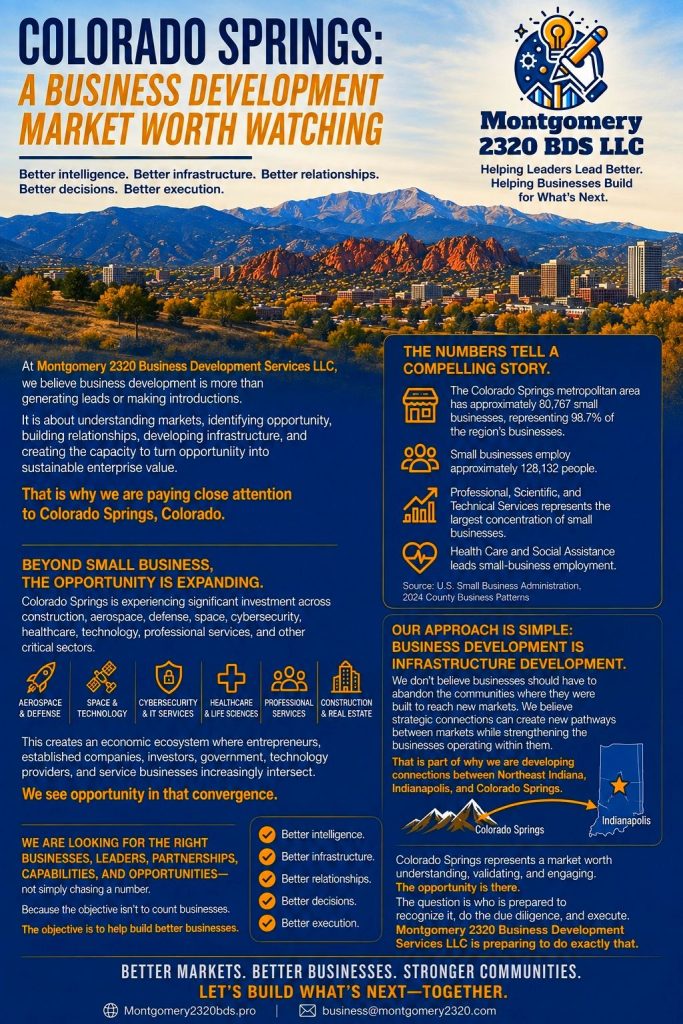
    The U.S. Small Business Administration’s 2025 Colorado Springs metropolitan-area profile places the region at approximately 80,767 small businesses, representing 98.7% of all businesses in the metro area and employing roughly 128,132 people.

    That is not a niche market. That is an economic ecosystem — and it represents a significant business-development opportunity for firms capable of helping companies build, improve, connect, acquire, expand, and prepare for what comes next.

    The opportunity sharpens further beneath the headline figure. Small employers in the Colorado Springs metro grew from 13,071 in 2012 to 15,718 in 2022, while small-business employment climbed from roughly 98,911 to 128,132 over the same period. Professional, Scientific, and Technical Services now represent the largest concentration of small businesses, with 11,718 firms as of 2022, while Health Care and Social Assistance leads small-business employment at 22,337 workers.

    This is not simply an economy with a large number of small companies. It is an economy composed of businesses that require expertise, infrastructure, capital, leadership, technology, workforce development, market access, operational improvement, and strategic relationships to reach their next stage of growth.

    That is where Montgomery 2320 enters the conversation.

    Our Position

    Business development is infrastructure development.

    We believe businesses need more than advice — they need the capacity to execute. That means:

    • Better systems
    • Better intelligence
    • Stronger relationships
    • Access to markets
    • Operational discipline
    • Leadership development
    • Technology that actually improves the enterprise
    • A clear understanding of their numbers, their customers, and their competitive environment

    And, perhaps most importantly, they need to understand what their business must become before the market forces the change on its own terms.

    Momentum Beyond the Small-Business Base

    Colorado Springs is demonstrating economic momentum that extends well past its small-business density. The City of Colorado Springs reported $4.7 billion in new construction value since June 2023, alongside 16 economic-development agreements secured over the same window projected to generate approximately 2,700 jobs and $1.1 billion in capital investment. The city has also awarded more than $2.1 million in Thrive loans to 94 small businesses and reached nearly 450 businesses through its Small Business Walks initiative.

    The Colorado Springs Chamber & EDC reports that nine new and expanding business projects in 2025 alone represented 1,115 jobs and approximately $499.4 million in capital investment across the Pikes Peak region.

    This is the convergence Montgomery 2320 looks for: small-business density, business formation, capital investment, infrastructure development, workforce requirements, technology, aerospace and defense, professional services, healthcare, construction, and advanced manufacturing — operating together within an increasingly sophisticated regional economy.

    Colorado Springs also carries a distinct aerospace, defense, space, and cybersecurity identity. Colorado’s 2025 Business Economic Outlook reports that aerospace and defense accounts for more than 40% of the Colorado Springs economy, anchored by more than 200 space, aerospace, cybersecurity, and defense companies employing approximately 111,000 people.

    That combination — established enterprises, emerging companies, entrepreneurs, government, defense-related industry, technology firms, professional-service providers, and small businesses, all operating within the same economic ecosystem — is exactly the environment where strategic business development creates leverage.

    Part of a Broader Corridor, Not Just a Market

    Montgomery 2320 does not approach Colorado Springs as an isolated geographic target. We approach it as one node in a broader business-development corridor connecting Northeast Indiana, Indianapolis, and Colorado Springs — built on a simple premise:

    Businesses should be able to expand their economic reach without abandoning the communities where they were built.

    A company in Indiana may hold capabilities a Colorado company needs. A Colorado company may hold market access, technology, relationships, or opportunities an Indiana company can leverage. Entrepreneurs need infrastructure. Established companies need new markets. Owners need succession and acquisition strategies. Emerging companies need business intelligence before making major decisions. Investors need better information before capital moves.

    That last point carries particular weight, and it reflects the governing principles Montgomery 2320 operates by:

    • Business development without due diligence is speculation.
    • Growth without infrastructure is fragile.
    • Capital without intelligence is exposed.
    • Relationships without execution are simply conversations.

    Our objective is to move beyond conversation — toward intelligence over assumption, field validation over theory, and long-term positioning over short-term gain.

    Building the Infrastructure Behind the Opportunity

    Montgomery 2320 Business Development Services LLC is focused on building the economic infrastructure that allows businesses and business owners to make better decisions — and execute those decisions with greater confidence. In practice, that means:

    • Developing businesses directly
    • Helping other businesses develop
    • Building strategic relationships
    • Connecting markets
    • Evaluating opportunities
    • Improving business infrastructure
    • Supporting acquisitions and portfolio development
    • Leveraging technology and artificial intelligence
    • Developing business intelligence
    • Creating practical pathways for businesses to become stronger, more resilient, and more valuable

    Colorado Springs gives us an important market in which to continue that work. But with more than 80,000 small businesses across the metro area, the goal was never to chase 80,767 companies. The goal is to find the right companies, the right owners, the right leaders, the right partnerships, the right opportunities, and the right convergence of capability and market.

    Because the objective is not to count businesses. The objective is to help build better ones.

    That is business development. That is infrastructure development. That is the work Montgomery 2320 Business Development Services LLC exists to do.

    The Question That Matters

    The market is moving. Capital is moving. Technology is moving. Businesses are adapting.

    The question is no longer whether opportunity exists in Colorado Springs — the data settles that. The real question is who is prepared to recognize it, validate it, build around it, and execute.

    Montgomery 2320 is preparing to do exactly that.

    Helping Leaders Lead Better. Helping Businesses Build for What’s Next.
  • Vertical Integration: A Strategic Growth Framework for Businesses Operating in a Rapidly Changing Economy

    Montgomery 2320 Business Development Services LLC | June 19th, 2026


    The business environment of 2026 is fundamentally different from the environment most companies operated in just a decade ago. Supply chain disruptions, labor shortages, inflationary pressures, geopolitical uncertainty, artificial intelligence, automation, and changing consumer expectations have exposed a critical weakness in many organizations: dependence on external systems they do not control.

    Vertical Integration Framework


    As a result, vertical integration has moved from being a strategy used primarily by large corporations to becoming a competitive necessity for businesses seeking long-term sustainability, profitability, and scalability.
    What Is Vertical Integration?
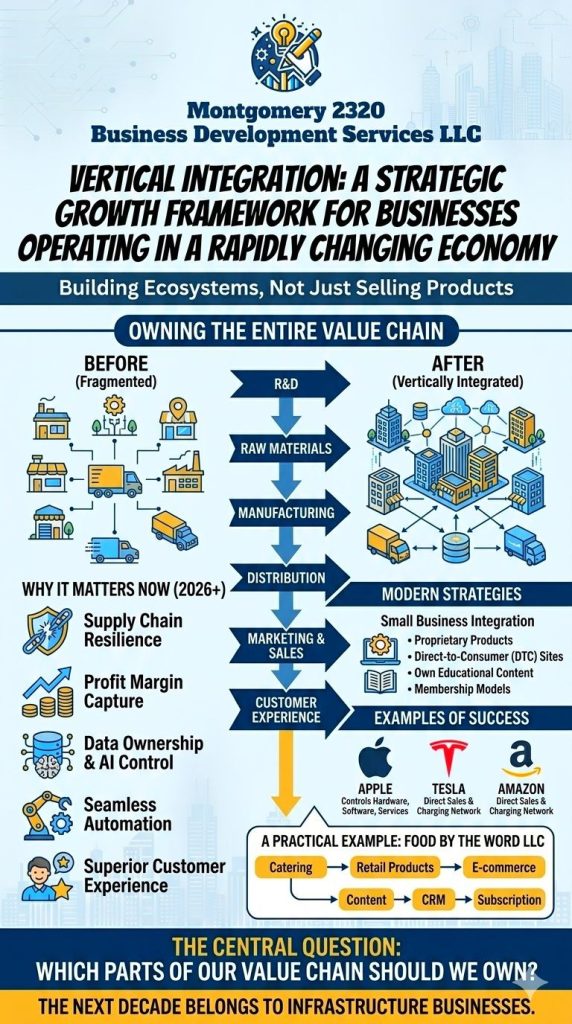
    Vertical integration is the process of expanding ownership or control over multiple stages of a company’s value chain rather than relying exclusively on third-party providers.


    In simple terms, a business moves beyond selling a product or service and begins controlling the systems that produce, distribute, market, support, or deliver that product or service.


    Instead of operating as a single point within a supply chain, the company becomes responsible for multiple stages of the process.


    Traditional Example
    A restaurant traditionally:
    • Purchases ingredients from distributors
    • Uses third-party marketing companies
    • Relies on delivery platforms
    • Depends on external training providers


    A vertically integrated restaurant might:
    • Manufacture proprietary seasonings
    • Operate its own e-commerce platform
    • Develop its own training programs
    • Maintain direct customer databases
    • Manage portions of its own logistics and fulfillment


    Each additional layer increases control while reducing dependence on outside organizations.


    The Two Types of Vertical Integration
    Backward Integration
    Backward integration occurs when a company gains control over suppliers or production resources.


    Examples include:
    • A bakery purchasing a flour mill
    • A retailer launching private-label products
    • A food distributor creating its own manufacturing operation
    • A logistics company developing proprietary software systems


    The objective is to control costs, quality, and supply continuity.
    Forward Integration
    Forward integration occurs when a company gains control over distribution and customer access.


    Examples include:
    • Manufacturers selling directly to consumers
    • Farmers opening retail stores
    • Consultants creating online education platforms
    • Product companies launching subscription services


    The objective is to own customer relationships and maximize profit margins.

    ───

    Why Vertical Integration Matters More Today Than Ever


    1. Supply Chain Volatility Is the New Normal
    For decades, businesses optimized for efficiency.


    Today, successful businesses optimize for resilience.


    The COVID-era disruptions demonstrated how quickly a company can lose access to inventory, transportation, labor, and production capacity.


    Organizations that controlled more of their supply chain recovered faster because they had fewer external dependencies.
    The future belongs to businesses that can continue operating when external systems fail.


    2. Profit Margins Are Being Compressed
    Every intermediary takes a percentage of value.


    Manufacturers. Distributors. Advertising platforms. Marketplaces. Payment processors. Delivery services.
    When businesses depend entirely on third parties, margins become increasingly compressed.


    Vertical integration allows organizations to capture more of the value they create.


    Instead of earning profit from a single activity, they generate revenue from multiple points throughout the value chain.


    3. Data Has Become a Strategic Asset
    Many businesses still allow third-party platforms to own their customer relationships.


    When a customer purchases through a marketplace, social media platform, or delivery application, valuable customer intelligence often remains with that platform.


    Vertically integrated organizations increasingly:
    • Build direct sales channels
    • Own customer databases
    • Control analytics
    • Capture behavioral insights
    • Develop predictive business intelligence


    In the AI era, the organization that owns the data often gains the greatest competitive advantage.


    4. Automation Favors Integrated Systems


    Artificial intelligence and automation perform best when systems communicate seamlessly.


    A business operating disconnected software, vendors, and service providers often experiences data fragmentation.


    Vertically integrated organizations can create unified ecosystems where:
    • Sales data drives inventory decisions
    • Inventory data triggers procurement
    • Procurement data informs forecasting
    • Forecasting data supports financial planning


    This creates a self-improving operational system that becomes increasingly efficient over time.


    5. Customer Experience Has Become a Competitive Advantage


    Consumers increasingly value consistency, speed, transparency, and reliability.


    Businesses controlling multiple stages of customer interaction can deliver a superior experience because fewer external organizations influence outcomes.


    The result is:
    • Better customer retention
    • Stronger brand loyalty
    • Increased recurring revenue
    • Higher lifetime customer value

    ───

    Modern Examples of Vertical Integration
    Some of the world’s most successful companies have embraced vertical integration as a core strategy.


    • Apple Inc.- controls hardware, software, services, and retail distribution.
    • Tesla Inc. – controls vehicle manufacturing, software, charging infrastructure, and direct sales.
    •  Amazon – controls fulfillment centers, transportation networks, cloud infrastructure, marketplaces, and media assets.


    Their success is not simply about size.
    It is about controlling strategic infrastructure.

    ───

    Vertical Integration for Small Businesses
    Many entrepreneurs incorrectly assume vertical integration is only for billion-dollar corporations.


    In reality, modern technology has dramatically lowered barriers to entry.


    A small business can vertically integrate by:
    • Developing proprietary products
    • Building direct-to-consumer websites
    • Creating educational content
    • Launching membership communities
    • Managing digital marketing internally
    • Building subscription-based revenue models
    • Using AI-powered business intelligence tools
    • Creating strategic partnerships that reduce dependency on intermediaries


    Vertical integration is not about owning everything.


    It is about controlling the most critical components of value creation.

    ───

    A Practical Example: Food By The Word LLC
    Food By The Word LLC provides a practical example of progressive vertical integration.


    The company evolved from a catering operation into a diversified enterprise that now includes:
    • Retail product sales
    • E-commerce infrastructure
    • Content creation
    • Educational resources
    • Product branding
    • Customer relationship management
    • Direct fulfillment
    • Search engine optimization
    • Subscription-based business relationships


    Rather than relying exclusively on external distribution channels, the organization has developed multiple revenue-producing assets that work together within a unified business ecosystem.


    This approach increases operational resilience while creating opportunities for scalable growth.

    ───

    The Future of Vertical Integration


    The next decade will likely separate businesses into two categories:


    Transaction Businesses


    Organizations that sell products or services but control very little of the value chain.
    These businesses remain vulnerable to:
    • Market disruptions
    • Vendor price increases
    • Platform policy changes
    • Competitive pressure


    Infrastructure Businesses


    Organizations that own critical systems within their value chain.
    These businesses gain:
    • Greater pricing power
    • Stronger margins
    • Better customer retention
    • Improved operational resilience
    • Enhanced data ownership
    • Greater scalability


    The companies that thrive in the coming decade will not simply sell products.
    They will build ecosystems.

    ───

    Conclusion
    Vertical integration is no longer merely a growth strategy. It is increasingly becoming a risk management strategy, a profitability strategy, and a competitive advantage strategy.


    In an environment shaped by artificial intelligence, supply chain volatility, economic uncertainty, and accelerating technological change, businesses that control more of their operational infrastructure are better positioned to adapt, scale, and endure.

    The central question business leaders should be asking is no longer:
    “What business are we in?”

    The more important question is:
    “Which parts of our value chain should we own?”

    The answer to that question may determine which organizations lead their industries over the next decade and which struggle to remain relevant.

  • MONTGOMERY 2320 BUSINESS DEVELOPMENT SERVICES LLC

    Strategic Analysis Brief Overview

    MONTGOMERY 2320 BUSINESS DEVELOPMENT SERVICES LLC

    Strategic Analysis Brief Overview

    M2320BDS – June 2026

    Executive Update Summary

    Since its inception, Montgomery 2320 Business Development Services LLC (M2320 BDS) has evolved from a localized entrepreneurial support initiative into a multi-regional business development organization focused on entrepreneurship, business intelligence, strategic networking, leadership development, and economic opportunity creation.

    Through seminars, mastermind groups, educational programming, business consulting, relationship-building initiatives, and community engagement, Montgomery 2320 BDS has directly contributed to the development of dozens of entrepreneurs, business owners, community leaders, and professionals throughout Indiana and beyond.

    This report provides a historical overview and strategic assessment of the organization’s development from 2019 through June 2026.


    Phase I: Foundation and Entrepreneurial Ecosystem Development (2019–2020)

    The years 2019 and 2020 established the operational foundation of Montgomery 2320 Business Development Services LLC.

    Operating from Refinery46 in Indianapolis, Indiana, Montgomery 2320 BDS became an active contributor within one of Indiana’s most dynamic entrepreneurial environments.

    Key accomplishments included:

    • Hosting and coordinating multiple small business development mastermind sessions.
    • Building relationships with startup founders, entrepreneurs, and local business leaders.
    • Active participation in the Geist Networking Lunch Club (GNLC).
    • Weekly strategic networking focused on collaboration, referrals, and business growth.
    • Delivering personal and professional development support to more than 50 entrepreneurs and business owners.

    During this period, the organization became recognized for providing practical business guidance, strategic planning assistance, entrepreneurial accountability, and business development mentorship.

    The Refinery46 office served as both an operational headquarters and entrepreneurial learning laboratory where numerous business concepts, partnerships, and growth strategies were developed and tested.


    Phase II: Educational Leadership and Event Expansion (2021–2022)

    In 2021, Montgomery 2320 BDS transitioned from small-group development initiatives into larger-scale educational programming.

    The inaugural Montgomery 2320 Business Development Seminar was launched at Refinery46.

    The event assembled a diverse panel of entrepreneurs representing multiple industries who shared:

    • Startup experiences
    • Growth challenges
    • Business development methodologies
    • Leadership lessons
    • Entrepreneurial success strategies

    The event demonstrated the organization’s ability to convene experienced professionals and create value-driven educational experiences.

    Building on this momentum, 2022 marked significant expansion.

    Major initiatives included:

    Montgomery 2320 Business Development Seminar (Second Annual)

    The second annual seminar expanded professional participation and attracted attendees from outside the Indianapolis market.

    Food By The Word Health Symposium

    Montgomery 2320 BDS coordinated and hosted a multidisciplinary health and wellness symposium featuring professionals from:

    • Martial Arts
    • Physical Therapy and Yoga
    • Acupuncture

    The symposium successfully attracted participants from multiple regions and demonstrated the organization’s ability to create educational experiences that bridged entrepreneurship, wellness, and community development.

    This period established Montgomery 2320 BDS as a respected convener of knowledge-sharing events capable of delivering meaningful educational outcomes.


    Phase III: Regional Expansion and Market Diversification (2022–2023)

    Following three productive years at Refinery46, a strategic operational shift was executed.

    Business operations were consolidated into the organization’s office in Lagro, Indiana.

    The move was motivated by several strategic considerations:

    • Geographic centralization
    • Reduced operational complexity
    • Expansion toward Northeast Indiana
    • Increased engagement with the Fort Wayne business ecosystem
    • Long-term regional growth opportunities

    Rather than retreating from Indianapolis, the move created a dual-market operating strategy that maintained relationships in Central Indiana while establishing new connections throughout Northeast Indiana.

    Throughout 2023, Montgomery 2320 BDS invested substantial effort into building relationships within the Fort Wayne entrepreneurial community.

    After a year of networking and market observation, the organization launched its Third Annual Business Development Seminar at the historic Electric Works campus.

    The event represented one of the most ambitious initiatives undertaken by the organization to date.

    Working alongside Electric Works event leadership, the organization coordinated:

    • Speaker recruitment
    • Marketing campaigns
    • Venue planning
    • Event logistics
    • Professional networking opportunities

    Although attendance and speaker participation ultimately fell below initial projections, the event delivered meaningful educational value and reinforced an important organizational principle:

    Long-term impact is often built through consistent execution rather than short-term attendance metrics.

    The seminar successfully brought together professionals from both Indianapolis and Fort Wayne, creating valuable cross-market relationship opportunities.


    Phase IV: Strategic Reassessment and Leadership Discipline (2024)

    The year 2024 represented a critical leadership and organizational maturity phase.

    Following the 2023 event, a planning committee was formed with the objective of transforming the annual seminar into a larger-scale business conference.

    Over a five-month planning cycle, Montgomery 2320 BDS worked extensively to elevate the event’s quality and regional significance.

    A major milestone was achieved when internationally recognized entrepreneur and business executive Matthew Knowles agreed to participate as keynote speaker.

    The opportunity represented a substantial leap forward in conference potential.

    However, organizational leadership recognized that event execution standards had increased significantly.

    After evaluating committee engagement levels, operational capacity, and organizational readiness, a strategic decision was made to postpone the conference rather than deliver a compromised experience.

    While difficult, the decision demonstrated disciplined leadership and a commitment to excellence over expediency.

    The decision preserved organizational credibility and laid the groundwork for future development.


    Phase V: Strategic Intelligence and Interstate Opportunity Development (2025)

    The evolving economic and political environment during 2025 presented new challenges.

    As market uncertainty intensified, Montgomery 2320 BDS made the strategic decision to cancel its planned Evolution 2025 conference initiative.

    Rather than forcing execution under unstable conditions, organizational resources were redirected toward strategic intelligence gathering and future opportunity identification.

    A significant milestone occurred through an extensive due diligence mission to Colorado Springs, Colorado.

    Conducted in collaboration with Future Due Diligence LLP, the initiative focused on:

    • Market observation
    • Economic analysis
    • Relationship development
    • Business ecosystem evaluation
    • Expansion opportunity assessment

    The resulting findings revealed substantial opportunities for future collaboration between Indiana and Colorado.

    This led to the conceptual development of an Indiana-Colorado Business Corridor strategy designed to facilitate:

    • Entrepreneurial collaboration
    • Business development programming
    • Cross-market networking
    • Innovation initiatives
    • Economic development partnerships

    Simultaneously, Montgomery 2320 BDS maintained its commitment to community service by providing weekly pro bono entrepreneurial assistance focused on:

    • Business planning
    • Strategic development
    • Artificial Intelligence integration
    • Internet of Things opportunities
    • Operational improvement


    Phase VI: Momentum Recovery and Organizational Advancement (2026)

    By June 2026, Montgomery 2320 BDS had successfully reactivated its in-person programming and relationship-building efforts.

    Key accomplishments include:

    M2320 BDS Consortium Meeting

    The January consortium gathering facilitated meaningful business engagement and knowledge exchange among professionals and entrepreneurs.

    Montgomery 2320 Business Seminar

    The May seminar continued the organization’s long-standing commitment to entrepreneurial education and business development.

    Refinery46 Reengagement

    The organization renewed collaboration with its historical Indianapolis partners, including activities hosted through Refinery46 and Donatos Pizza.

    Measured Impact

    As of June 2026:

    • 21 additional business owners have received direct value from Montgomery 2320 BDS programming.


    • Business intelligence resources have been shared.


    • Marketing assistance has been provided.


    • Strategic business-to-business introductions have been facilitated.


    • New relationship-development opportunities have been created.


    Strategic Assessment

    Montgomery 2320 Business Development Services LLC has demonstrated a consistent pattern of:

    • Entrepreneurial leadership
    • Community engagement
    • Strategic adaptability
    • Educational programming excellence
    • Relationship-driven growth

    Perhaps most importantly, the organization has demonstrated resilience.

    Not every initiative achieved its original scale or participation goals. However, each initiative generated valuable lessons, expanded relationships, and strengthened organizational capability.

    The cumulative result is a business development organization that has successfully built a reputation for creating meaningful connections, delivering practical business education, and helping entrepreneurs navigate an increasingly AI-mediated and rapidly changing economic landscape.

    Looking forward, Montgomery 2320 BDS is uniquely positioned to capitalize on:

    • AI-driven business transformation
    • Interstate economic partnerships
    • Entrepreneurial ecosystem development
    • Business intelligence services
    • Strategic networking infrastructure
    • Regional economic corridor initiatives

    The organization’s next phase of growth will likely be defined not merely by events hosted, but by ecosystems built, relationships cultivated, and opportunities created for business owners seeking sustainable and profitable growth in a rapidly evolving marketplace.

    Prepared For Internal Strategic Review

    Montgomery 2320 Business Development Services LLC

    June 2026

  • The Employer–Employee Relationship Is Changing Forever — And Most Businesses Are Not Prepared

    The Employer–Employee Relationship Is Changing Forever — And Most Businesses Are Not Prepared

    The Employer–Employee Relationship Is Changing Forever — And Most Businesses Are Not Prepared
#BusinessDevelopment #Leadership #FutureOfWork #BusinessStrategy #Entrepreneurship #ArtificialIntelligence #Operations #EconomicTrends #Consulting #SmallBusiness #Innovation #ContractWork #FutureBusiness #ExecutiveLeadership
    “Montgomery 2320 is the structure builder for your business”

    By Montgomery 2320 Business Development Services | 5●27●2026

    Business owners need to confront a difficult reality:

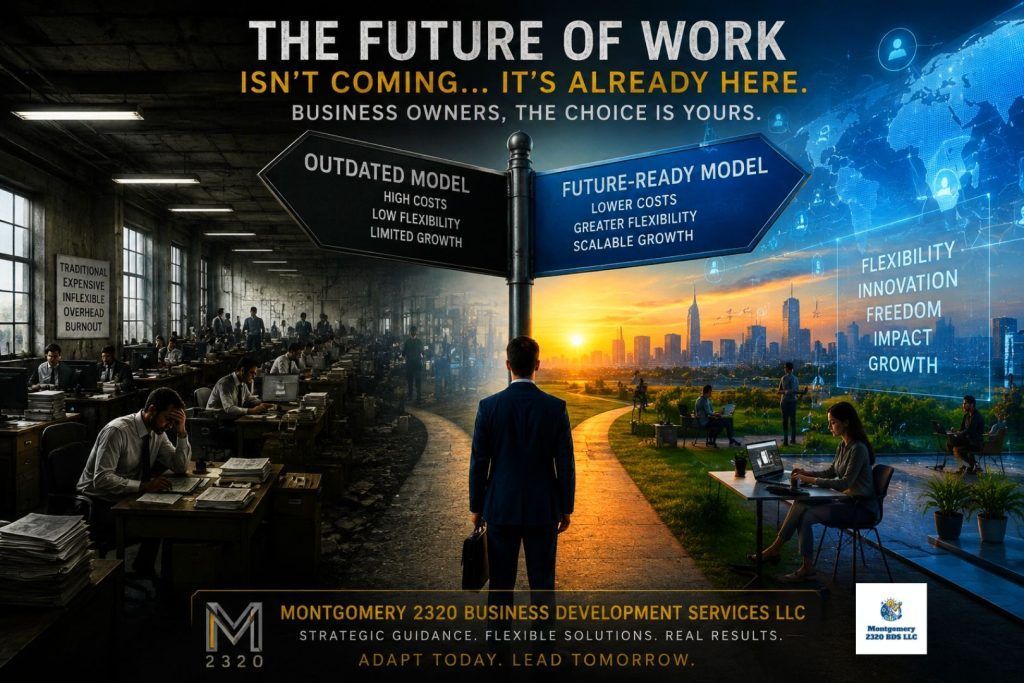
    The traditional labor model that built much of modern corporate America is undergoing a permanent transformation.

    For decades, success was measured by the size of your workforce, the number of departments you operated internally, and the amount of labor you could manage under one roof. Large employee structures were viewed as signs of stability, strength, and growth.

    Today, those same structures are increasingly becoming operational liabilities.

    The economics of labor have changed.

    Rising benefit costs, wage pressures, declining productivity ratios, burnout, workforce disengagement, compliance burdens, rapid technological advancement, and AI-assisted operational systems are forcing companies to rethink how work is performed and who performs it.

    This is not political.
    It is not emotional.
    It is economic.

    Across multiple industries, businesses are quietly shifting away from large permanent labor models and toward leaner operational ecosystems built around:
    • Contractors
    • Fractional leadership
    • Strategic consulting firms
    • AI-supported infrastructure
    • Specialized project teams
    • Outsourced execution models
    • Remote operational support systems

    Why?

    Because flexibility now carries more value than permanence.

    The market no longer rewards unnecessary operational weight.

    Many companies have discovered that hiring specialized firms on a project-by-project basis can produce faster execution, lower long-term liabilities, and greater strategic efficiency than maintaining oversized internal departments operating below full productive capacity.

    This is one of the defining business shifts of our generation.

    Yet many organizations are still operating with outdated assumptions about labor, productivity, and scalability.

    Too many businesses are trying to preserve systems designed for a different economic era while the marketplace continues accelerating toward automation, decentralized execution, and precision-based operational structures.

    The future business model is not centered around maintaining the largest workforce possible.

    The future business model is centered around:
    • Operational agility
    • Specialized expertise
    • Scalable infrastructure
    • Adaptive execution
    • Strategic partnerships
    • Intelligent cost management

    This is why firms like Montgomery 2320 Business Development Services LLC are becoming increasingly relevant in the modern economy.

    Businesses no longer simply need employees.
    They need strategic guidance, operational intelligence, flexible execution systems, and leadership capable of helping them navigate uncertainty at scale.

    The companies that understand this shift early will gain significant competitive leverage over the next decade.

    The companies that refuse to adapt may find themselves carrying labor structures and operational overhead the market no longer supports.

    Another major reality business leaders must prepare for is this:

    Many future jobs do not even exist yet.

    Think carefully about that.

    Entire generations are being trained for evolving industries while businesses simultaneously reduce dependency on traditional long-term staffing models. This creates a transition period where companies increasingly rely on contractors, consultants, strategic partnerships, automation, and temporary specialized labor to remain competitive.

    This is not fear mongering.
    This is strategic observation based on where business infrastructure is heading globally.

    The labor dynamic has changed.
    The speed of business has changed.
    The expectations of scalability have changed.

    Business owners must stop asking:
    “How do we get back to the old normal?”

    And start asking:
    “How do we build intelligently for the future that is already arriving?”

    The answer to that question may determine which businesses survive the next decade — and which ones become case studies of operational stagnation.

  • Building Real Business Infrastructure Through Relationships

    Montgomery 2320 Business Development Services LLC Seminar Recap

    May 7, 2026 | Refinery 46

    There is a major difference between a networking event and a strategic business gathering.

    One is built around transactions.
    The other is built around trust, accountability, shared vision, and long-term collaboration.

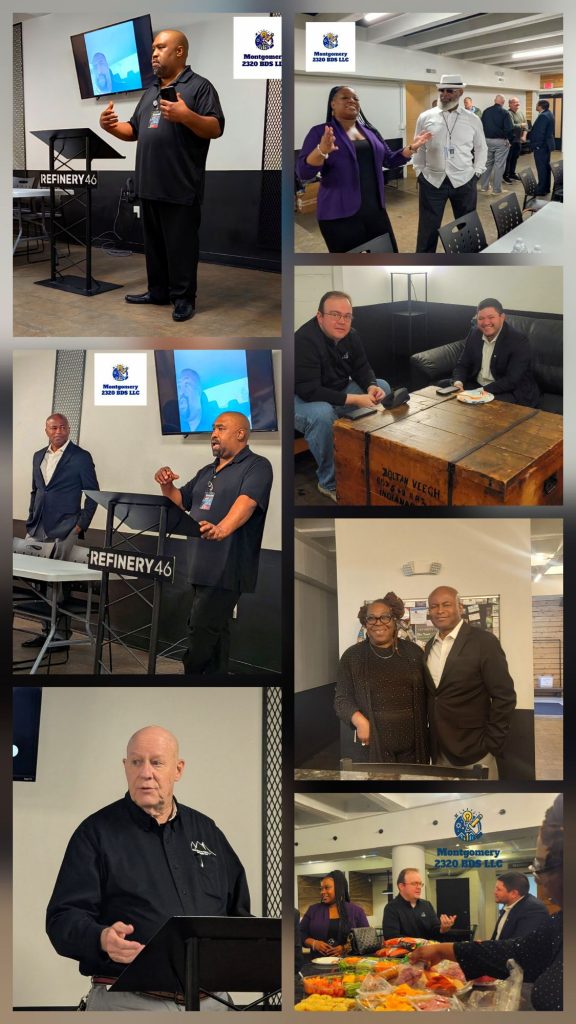
    On May 7, 2026, Montgomery 2320 Business Development Services LLC had the privilege of hosting a powerful business development seminar at Refinery 46 that brought together entrepreneurs, executives, community leaders, public servants, emerging professionals, and strategic thinkers from across the Indianapolis business ecosystem.

    What took place throughout the day was far bigger than exchanging business cards or promoting services. It was a deliberate effort to strengthen the connective tissue between people who are serious about building sustainable businesses, developing stronger leadership capacity, and contributing to the long-term economic growth of Indianapolis.

    Beginning promptly at 10:00 a.m., attendees entered an environment intentionally designed around collaboration, faith, operational growth, authentic conversation, and meaningful relationship building. From the very beginning, the atmosphere reflected something increasingly rare in today’s business culture: genuine engagement.

    Nearly everyone in attendance was meeting for the first time.

    That mattered.

    In a marketplace where many people stay trapped inside familiar circles and transactional conversations, this seminar created space for new introductions, fresh perspectives, and the formation of relationships capable of producing future partnerships, referrals, collaborations, and business opportunities.

    One of the foundational reasons the event operated at such a high level was the outstanding support and leadership provided by Lowayne Montgomery, owner of Strength Of A Name LLC. Her professionalism, hospitality coordination, setup assistance, and servant leadership were instrumental in helping create an organized, welcoming, and engaging environment for every attendee throughout the day. Excellence in execution does not happen accidentally, and her contribution played a major role in establishing the tone and operational flow of the seminar.

    Special appreciation also goes to Addison Newell and the entire team at Refinery 46 for their partnership and hospitality. Over the last seven years, Refinery 46 has continued evolving into one of Indianapolis’ strongest entrepreneurial environments. Returning to the facility and witnessing its modernization and expansion reinforced just how important collaborative innovation hubs have become for small and midsize businesses operating inside today’s rapidly shifting economy.

    The seminar itself was strengthened by an exceptional lineup of speakers and participants who each contributed valuable perspective and insight.

    Vop Osili delivered thoughtful commentary regarding the future direction of Indianapolis, the responsibility business owners carry in shaping economic growth, and the opportunities currently available for small and midsize businesses throughout the city. What stood out most, however, was not simply the presentation itself. It was his willingness to remain engaged throughout the day — speaking directly with attendees, listening to concerns, participating in fellowship, and investing time into authentic conversation. Leadership accessibility matters, and his presence reinforced the importance of direct engagement between civic leadership and the entrepreneurial community.

    The seminar was also honored by the attendance of George Hornedo, whose participation further strengthened the collaborative atmosphere of the event. His willingness to engage openly with business owners and attendees contributed significantly to the day’s spirit of dialogue, accessibility, and community-focused leadership.

    One of the most impactful sessions of the afternoon came from Stephanie L. Bowie, whose presentation focused on financial structure, accounting discipline, operational clarity, and self-accountability inside business ownership. Her message challenged attendees to evaluate the integrity of their systems, their stewardship practices, and the operational realities behind their business goals. In today’s economy, vision without structure creates instability. Her presentation reinforced the importance of disciplined execution as the foundation for sustainable growth.

    Earlier in the day, Marty Moran delivered a powerful faith-centered presentation centered on storytelling, branding, relationship building, and purpose-driven entrepreneurship. Drawing from decades of entrepreneurial experience, Marty emphasized the importance of maintaining proper priorities: God first, people second, and business third. His testimony regarding launching and sustaining entrepreneurship later in life — including beginning his business journey after the age of 55 — offered encouragement and perspective to entrepreneurs across multiple generations and stages of business development.

    Perhaps one of the strongest elements of the seminar was the active participation from attendees themselves.

    This was not a passive audience.

    Participants contributed openly to discussions, shared personal experiences, exchanged strategic ideas, and created an atmosphere where mutual learning could occur organically. New relationships developed throughout the day among entrepreneurs, professionals, and community leaders, including meaningful connections involving individuals such as Ebony Ligons and Star Johnson, among many others.

    These moments represented exactly what Montgomery 2320 Business Development Services LLC was built to facilitate: authentic human connection that leads to long-term business development opportunity.

    The lunch fellowship portion of the seminar became one of the clearest demonstrations of this mission in action. Attendees shared meals, discussed operational challenges, exchanged contact information, explored collaboration opportunities, and developed relationships beyond surface-level introductions.

    That matters because real business ecosystems are not built on transactional encounters.

    They are built on trust.
    Consistency.
    Character.
    Shared values.
    And long-term relationship investment.

    Another major takeaway from the seminar was the strength created by generational diversity. The room included emerging entrepreneurs alongside seasoned business veterans, creating an environment where innovation and experience could sharpen one another simultaneously. Younger professionals gained access to wisdom and perspective earned through decades of business experience, while veteran entrepreneurs engaged with fresh ideas, modern perspectives, and evolving approaches to leadership and growth.

    That type of environment is increasingly valuable in today’s economy.

    Businesses that survive long term are not simply the fastest moving. They are the ones capable of combining wisdom, adaptability, operational discipline, innovation, and strong relational infrastructure.

    This seminar served as a real-time demonstration of Montgomery 2320 Business Development Services LLC’s ongoing mission: helping entrepreneurs, professionals, and organizations grow internally and externally through strategic relationship development, operational support, collaborative engagement, and business infrastructure building.

    Whether supporting newly launched ventures or established organizations preparing for expansion, the objective remains the same — helping businesses create sustainable pathways toward long-term growth, leadership development, operational clarity, and meaningful collaboration.

    And this is only the beginning.

    Additional seminars, collaborative initiatives, leadership development opportunities, and strategic business engagements are already being planned for the future. The momentum established during this gathering reinforced a powerful reality: Indianapolis possesses extraordinary entrepreneurial potential when leaders, builders, innovators, and professionals intentionally come together around shared growth and community advancement.

    We also strongly encourage entrepreneurs and organizations throughout Indianapolis to engage with Refinery 46 as a strategic business ecosystem partner. Its collaborative atmosphere, entrepreneurial infrastructure, centralized location, and commitment to innovation continue positioning it as one of the city’s most valuable environments for incubation, relationship development, and business growth.

    To every attendee, speaker, supporter, and participant who contributed to this event — thank you.

    The conversations started here matter.
    The relationships built here matter.
    And the long-term impact of those relationships is only beginning to unfold.

    The future of business development belongs to organizations willing to invest in people before transactions, collaboration before competition, and long-term infrastructure before short-term visibility.

    That is the work Montgomery 2320 Business Development Services LLC intends to continue building.

    M2320BDS Business Seminar May 7th, 2026
  • The Rising Cost of Schedule C Isn’t a Fee Increase — It’s a Structural Shift

    Montgomery 2320 Business Development Services LLC | Business Advisory Communication

    Small businesses did not suddenly become “more expensive” to operate.
    What changed is the system surrounding them.

    As we move through the 2025 tax cycle, one reality has become unavoidable:


    The cost of properly filing a Schedule C has increased, and that pressure is falling squarely on sole proprietors, freelancers, independent contractors, and micro-enterprises.

    Let’s be clear and precise.

    The IRS did not raise a fee to file Schedule C.
    There is no new government charge hiding in the fine print. What business owners are experiencing instead is a market-driven, structural shift in how compliance is achieved and who bears the burden.

    Why the Cost Has Increased — Without a New IRS Fee


    Several forces are converging at once:


    • Professional tax preparation fees have risen due to inflation, increased labor costs, higher professional liability insurance, and expanded regulatory oversight.
    • Tax reporting complexity has escalated, including stricter documentation standards, increased audit exposure, and evolving reporting mechanisms such as 1099-K thresholds and third-party payment disclosures.
    • Free or low-cost government filing options are being reduced or eliminated, quietly transferring responsibility back to the business owner.
    • Tax software pricing for self-employed filers has increased, often requiring paid upgrades just to file a compliant Schedule C.

    This is not a cosmetic change.
    This is risk exposure being reallocated downstream.

    Schedule C Is No Longer a “Simple Attachment”


    For today’s small business, Schedule C functions as a financial disclosure document, not a side form. It directly impacts:
    • Audit probability and exposure
    • Deduction defensibility
    • Income classification and reporting accuracy
    • Overall compliance posture
    • Long-term business credibility with lenders, partners, and agencies

    Errors here don’t stay isolated. They compound.

    Cutting corners on Schedule C preparation does not save money — it defers cost, often at a much higher price through penalties, amended returns, audits, or lost opportunities.

    The Strategic Reality Business Owners Must Accept

    Within Montgomery 2320 Business Development Services LLC, we advise clients plainly and without ambiguity:

    • Professional tax preparation is no longer optional for serious operators.

    • Compliance is a form of business insurance.

    • Proper filing is not about convenience — it is about coverage and protection.

    The quiet rollback of accessible free filing tools has reshaped the operating environment. Business owners are now expected to self-manage complexity or invest in professional support. Those who fail to adapt will pay later — financially and strategically.

    This Is the New Operating Environment
    Small businesses that intend to survive, scale, and maintain ownership must evolve with the system they operate in.
    Tax preparation is no longer an annual task to “get through.”

    It is a strategic function tied directly to:
    • Capital protection
    • Risk management
    • Operational credibility
    • Long-term sustainability

    In this environment:
    Compliance is capital protection.
    Preparation is risk management.
    Accuracy is leverage.

    Our Role
    Montgomery 2320 Business Development Services LLC exists to help businesses operate with clarity, resilience, and foresight — not reaction.

    We are a strategic business development firm focused on preparing companies for profitability, compliance stability, and ownership longevity in an increasingly AI-mediated and regulation-dense economy.
    If you’re building to last, this is the moment to get serious.

    Montgomery 2320 Business Development Services LLC
    Strategic Business Development | Compliance Advisory | Sustainability Planning

  • The Generation X Economic Squeeze—and the Strategic Imperative It Created

    The Economics that Gen X inherited

    By Montgomery 2320 BusinessDevelopment Services LLC – 01/12/2026

    Generation X represents one of the most economically underdiagnosed cohorts in modern American history. They are often mislabeled as resilient, adaptable, and self-sufficient—traits that are praised culturally but mask a deeper truth: Gen X was structurally disadvantaged by macroeconomic decisions made long before they entered the workforce. This was not accidental, and it was not cyclical. It was the predictable outcome of a policy regime that permanently altered the relationship between labor, capital, and long-term economic security.

    The Reagan administration did not merely introduce new economic policies; it rewired the operating system of the U.S. economy. That system rewarded asset ownership over labor contribution, financialization over production, and short-term capital efficiency over long-term workforce stability. Generation X inherited this system at precisely the wrong moment—after the benefits had been captured and before the costs were fully realized.

    A Generation Caught Between Prosperity and Precarity


    Gen X entered adulthood in an economy defined by wage stagnation, weakened labor protections, and rising costs of entry into the middle class. Productivity continued to rise, but wages did not follow. Education shifted from a public investment to a personal liability. Homeownership became asset-gated. Retirement security moved from institutional guarantees to individual risk exposure.

    In practical terms, Generation X became the first cohort forced to finance its own economic survival inside a system that no longer rewarded effort proportionately. They bore the downstream effects of deregulation, deficit-financed growth, and the erosion of collective bargaining—without the capital base or asset appreciation enjoyed by prior generations.
    This is not nostalgia. It is balance-sheet reality.

    Why This Matters Now


    Today, Generation X occupies senior leadership roles across enterprises, institutions, and small businesses. They are founders, operators, and decision-makers—yet many remain economically constrained relative to their responsibilities. Their businesses often operate undercapitalized. Their strategic decisions are shaped by risk aversion learned through repeated systemic shocks. Their growth potential is real but structurally throttled.

    This is the critical inflection point.
    The economic harm done to Generation X was diffuse, long-term, and invisible in headline data—but it created a latent demand for a new kind of business intelligence, capital strategy, and operational foresight. Traditional advisory models do not address this gap. They assume a level of financial resilience and systemic fairness that never existed for this cohort.

    Where Montgomery 2320 Is Positioned Differently


    Montgomery 2320 Business Development Services LLC exists precisely at this intersection of historical damage and future opportunity.

    We do not approach business development as transactional consulting. We operate as a strategic reconstruction partner for leaders and enterprises shaped by systemic constraint. Our work is grounded in one core principle: economic disadvantage created at the policy level must be countered at the strategic level.

    Our positioning is defined by four capabilities:
    1. Structural Diagnosis, Not Surface Metrics
    We analyze enterprises through a macro-to-micro lens—understanding how historical wage suppression, capital access gaps, and policy-driven risk transfer show up in today’s balance sheets, growth ceilings, and operational bottlenecks.

    2. Intelligence Over Information
    Data alone does not create an advantage. We transform fragmented financial, operational, and market data into decision-grade intelligence that accounts for volatility, asymmetry, and long-cycle risk—conditions Gen X leaders know all too well.

    3. Capital Strategy for the Capital-Constrained
    We design growth pathways that do not assume cheap money, infinite leverage, or institutional forgiveness. Our strategies prioritize durability, cash discipline, and strategic optionality—building enterprises that can grow without being fragile.

    4. Long-Horizon Business Architecture
    Having lived through multiple economic resets, Gen X leaders think in decades, not quarters. We align business models, governance structures, and expansion strategies with that reality—favoring compounding advantage over speculative scale.

    Turning Historical Disadvantage into Strategic Leverage


    What harmed Generation X also forged its strengths: realism, adaptability, and disciplined execution. Montgomery 2320 translates those traits into structured advantage. We help enterprises move from survival mode to strategic positioning—from reacting to systemic constraints to designing around them.

    This is not about revisiting past grievances. It is about acknowledging economic reality so it can be outperformed.

    Generation X does not need motivation. It needs precision, foresight, and structural clarity. Montgomery 2320 was built to deliver exactly that.

    The system changed the rules. We help our clients win anyway.

  • Dynamic markets demand dynamic business development. Period.

    By J.Robert Montgomery Sr. – 12/20/2025

    There is a reality most businesses are not ready to hear—and Montgomery 2320 Business Development Services LLC will say it plainly:
    If AI can’t find you, you don’t exist.

    Searchability is no longer a marketing tactic.
    It is infrastructure.

    Search Engine Large Language Models now sit upstream of customers, partners, investors, and procurement decisions. If your business is not structured to be discoverable, indexable, and readable by AI systems, your exposure drops to zero—regardless of how good your product or service is.
    Dead in the water means exactly that.

    Here’s where most companies get it wrong.
    They treat domains like an afterthought.

    They default to a .com or .org because that’s what everyone else did—joining the same overcrowded digital highway as 34 million other U.S. businesses, all competing for diminishing attention.

    That’s not a strategy. That’s inertia.
    Top-Level Domains (TLDs) matter—more than ever.


    There are hundreds of TLDs that can precisely signal your industry, authority, geography, and intent to both humans and machines. The right domain is not branding fluff; it’s a search signal, a positioning asset, and a discoverability multiplier.
    The real question is simple: Are you exclusive—or interchangeable?

    At Montgomery 2320 Business Development Services LLC, we don’t “build websites.”
    That model is obsolete.
    We engineer virtual brand identity ecosystems—digital architectures designed around the personality, positioning, and future trajectory of your business. Every structure we create is intentional, AI-accessible, and built to scale in a machine-driven economy.
    Cookie-cutter sites blend in.
    Blending in no longer converts.
    And in an AI-first world, it doesn’t even get seen.

    The businesses that will win this decade are not louder.
    They are more discoverable, more distinct, and structurally visible where decisions are now being made.

    Montgomery 2320 Business Development Services LLC exists to make sure your business is one of them.